
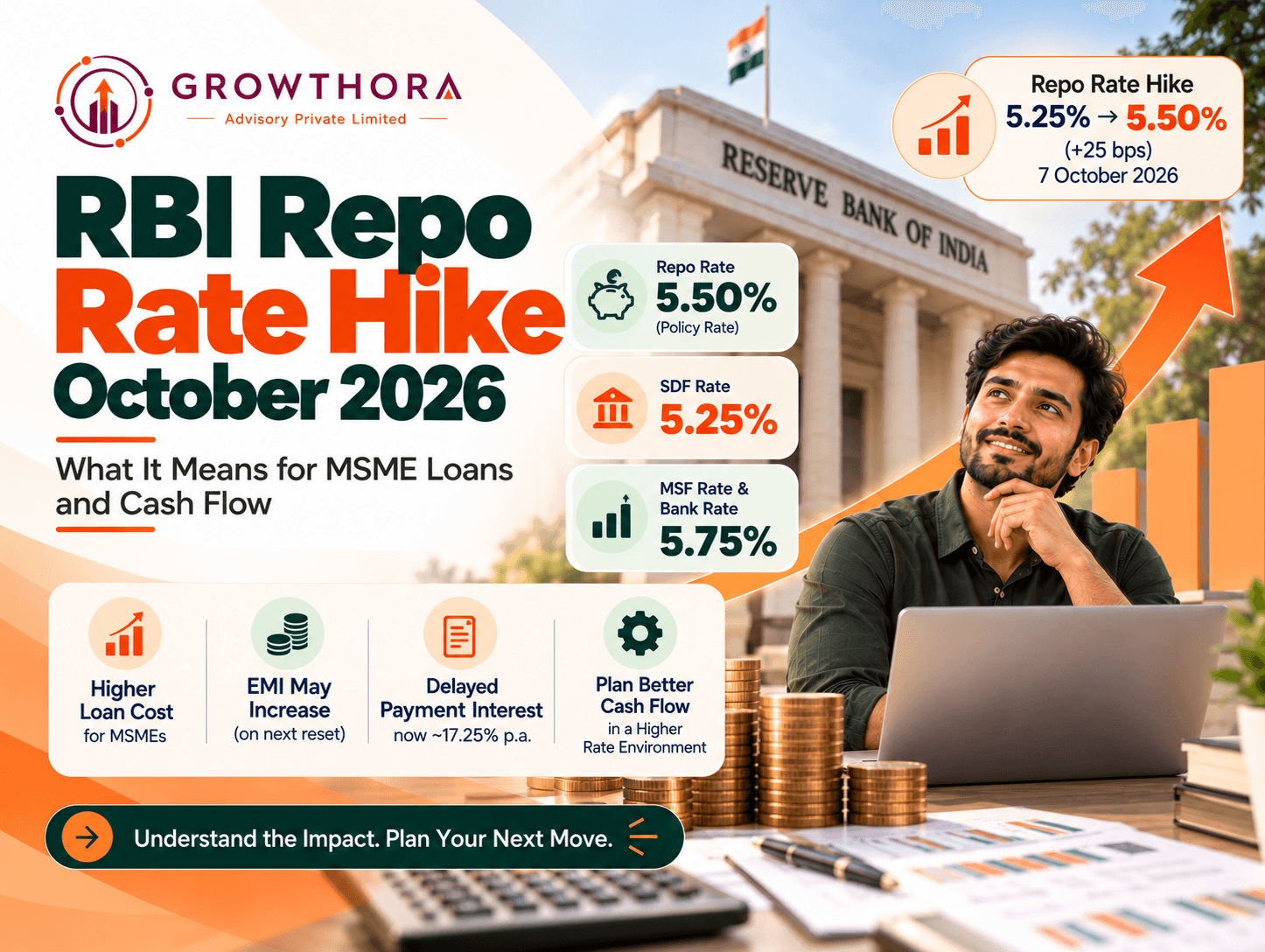
What the RBI decided on 7 October 2026
| Policy rate | Earlier | Now |
|---|---|---|
| Policy repo rate | 5.25% | 5.50% |
| Standing Deposit Facility (SDF) rate | 5.00% | 5.25% |
| Marginal Standing Facility (MSF) rate 5.50% 5.75% | 5.50% | 5.75% |
| Bank Rate | 5.50% | 5.75% |
| Policy stance | Neutral | Calibrated tightening |
Key Takeaways
- The hike was unanimous and is the first increase in the repo rate in nearly three years, signalling that RBI is now prioritising inflation and global uncertainty over growth support.
- The repo rate is 5.50%, the SDF rate is 5.25%, and the MSF rate and Bank Rate are 5.75% with immediate effect from 7 October 2026.
- Floating rate MSME loans linked to an external benchmark such as the repo rate typically see EBLR rise by the same 25 basis points, with the borrower's rate resetting at the lender's next reset date.
- A 25 basis point rise adds roughly ₹208 a month per ₹10 lakh of outstanding loan at a 5 year remaining tenure, though exact numbers depend on the lender and the structure of the loan.
- The statutory interest on delayed payments to micro and small suppliers is three times the Bank Rate compounded monthly, so the higher Bank Rate of 5.75% lifts that figure to about 17.25% a year.
- The stance shift to calibrated tightening suggests no near term rate cuts, so MSMEs should plan cash flow on the assumption that borrowing costs stay firm.
Why the RBI raised rates
- The Monetary Policy Committee voted unanimously to raise the repo rate, citing rising inflationary pressures and global uncertainties. By moving the stance from neutral to calibrated tightening, the RBI has signalled that further tightening is possible if inflation does not ease, and that near term rate cuts are unlikely.
- The repo rate is the rate at which the RBI lends short term money to banks. When it rises, banks' own funding costs rise, and most of that increase is passed on to borrowers through higher lending rates.
How the hike affects MSME loans
- Repo-linked floating rate loans: the lender's External Benchmark Lending Rate rises by about 25 basis points, and your interest rate resets at the next reset date set in your loan agreement.
- MCLR-linked loans: these adjust more slowly because MCLR depends on banks' cost of funds, but the direction is upward over the coming months.
- Fixed rate loans: existing fixed rate loans are not affected, but new loans will be priced higher.
- Working capital and overdraft limits: interest on drawn balances will rise, which squeezes margins for businesses that rely on revolving credit.
- NBFC and fintech loans: unsecured lenders usually raise rates faster, since their funding costs track the policy rate and market yields.
Why delayed payment interest also goes up
- Under the MSMED Act, 2006, a buyer who delays payment to a micro or small enterprise supplier must pay interest at three times the Bank Rate notified by the RBI, compounded with monthly rests. With the Bank Rate now at 5.75%, that works out to about 17.25% a year on overdue amounts, up from about 16.5% earlier.
- For MSMEs that are owed money, this strengthens the case for claiming interest on overdue invoices. For MSMEs that buy from other small suppliers, it raises the cost of paying late.
What MSME owners should do now
- Check your loan agreement to find the benchmark, spread and reset date for each floating rate loan.
- Ask your lender whether you can switch to a fixed rate or renegotiate the spread, especially if your credit profile has improved.
- Prepay high cost debt such as unsecured loans first, since the rate rise hurts these most.
- Tighten receivables by following up on invoices older than 45 days and claiming interest where payments are late.
- Use invoice discounting through TReDS to turn receivables into cash at market determined rates rather than drawing expensive overdraft.
- Rebuild your cash flow forecast with a higher interest cost for the next 12 months.
Frequently Asked Questions
What is the new repo rate after the October 2026 RBI policy?
The RBI raised the policy repo rate by 25 basis points from 5.25% to 5.50% on 7 October 2026, with immediate effect.
Did the RBI change its policy stance?
Yes, the Monetary Policy Committee shifted the stance from neutral to calibrated tightening.
Will my MSME loan EMI increase?
If your loan is a floating rate loan linked to the repo rate or another external benchmark, your rate or EMI will rise at the next reset date, while fixed rate loans stay unchanged.
What are the new SDF, MSF and Bank Rate levels?
The SDF rate is 5.25%, and both the MSF rate and the Bank Rate are 5.75% after the 7 October 2026 decision.
How does the repo rate hike affect delayed payment interest to MSMEs?
Interest on delayed payments to micro and small suppliers is three times the Bank Rate with monthly compounding, so the Bank Rate of 5.75% implies about 17.25% a year.
Are rate cuts likely soon?
The shift to calibrated tightening signals that near term cuts are unlikely, though future decisions will depend on inflation and global conditions.
Want to reduce the impact of higher interest rates on your business?
A short review of your loans, receivables and cash flow can reveal savings quickly. Book a free consultation with Growthora and we will help you restructure borrowing, recover overdue payments and plan around the new rate environment.
Next step
Apply this to your business.
Confirm whether this applies to your legal structure, industry classification, and credit history - in under 30 minutes with an advisor.