
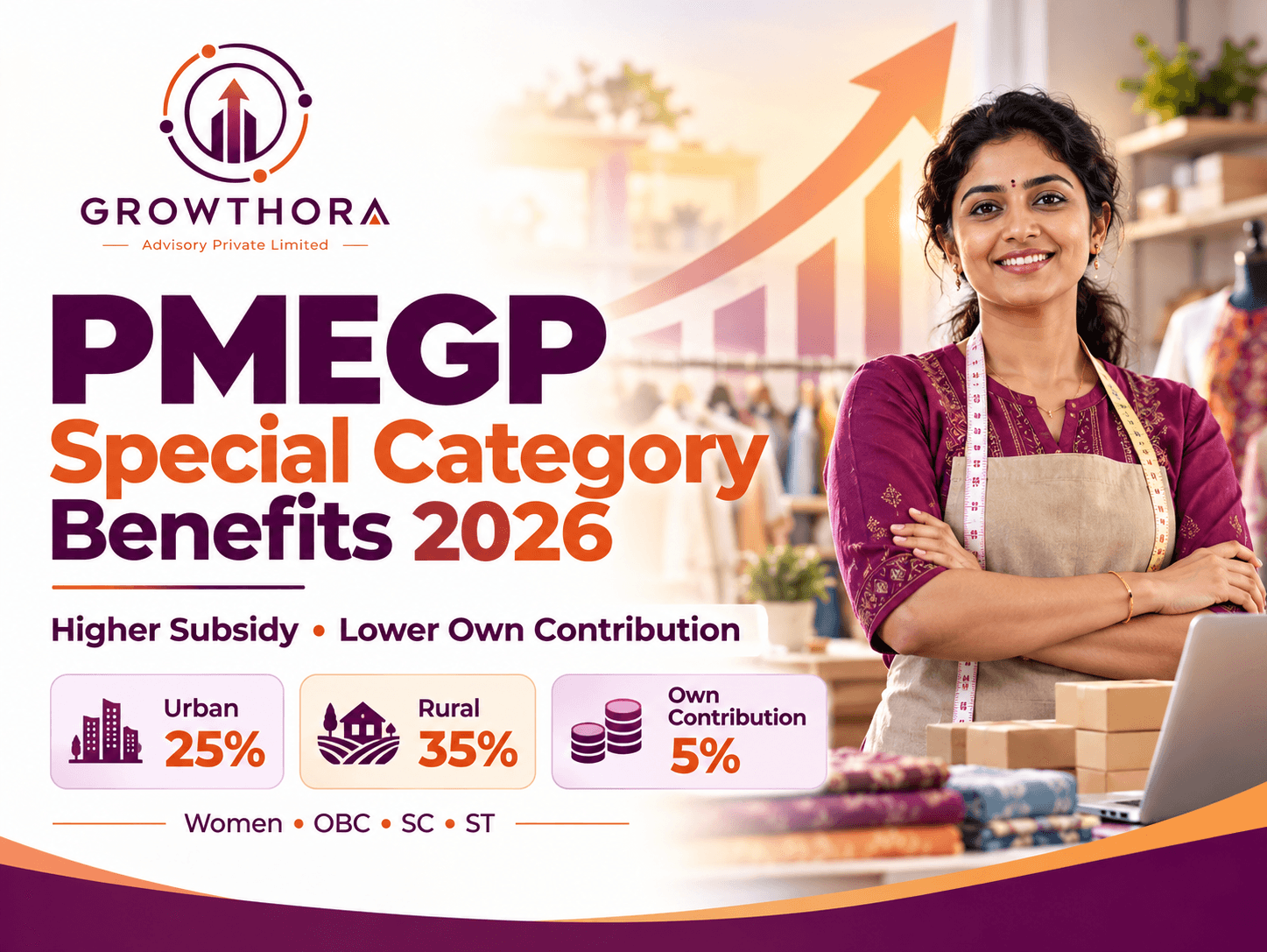
PMEGP special category subsidy rates
The rates below are for setting up a new enterprise under the published scheme guidelines. They are not the same as the separate assistance structure that may apply to an eligible second loan for upgrading an existing unit.
| Beneficiary category | Own contribution | Urban subsidy | Rural subsidy |
|---|---|---|---|
| Special category, including women, SC, ST, OBC, minorities, ex-servicemen, | 10% | 15% | 25% |
| transgender applicants, differently abled applicants and other listed notified categories | 5% | 25% | 35% |
The project location matters. A rural unit and an urban unit can receive different subsidy rates even when the applicant belongs to the same category. Ask the implementing agency how the proposed site is classified before finalising your project cost calculations.
Do women qualify for special category benefits regardless of caste?
The published PMEGP guidelines expressly include women in the special category. Therefore, a woman applicant does not need to belong to SC, ST or OBC solely to be included under the women category. A woman from the general category may qualify for the special category contribution and subsidy rates, subject to the scheme's other eligibility rules and proper application details.
Do not assume that every business structure or every person associated with a business automatically receives the benefit. The application should accurately identify the applicant or beneficiary and follow the current PMEGP rules for the proposed enterprise. If a business has multiple promoters or a non-individual ownership structure, confirm the permitted applicant structure with the implementing agency.
Who is included in the special category?
The revised PMEGP guidelines list SC, ST, OBC, minorities, women, ex-servicemen, transgender applicants, differently abled applicants, and certain applicants or units associated with the North Eastern Region, aspirational districts, and notified hill or border areas. The precise documentary basis can differ depending on the category being claimed.
Do not rely on a general internet list alone. Some location-based categories depend on the area being officially notified, while personal categories depend on the relevant certificate or service documentation. Ask the agency which proof it accepts for your particular claim.
How much subsidy could the project receive?
The subsidy rate is calculated against the eligible project cost, subject to the scheme's maximum project limits and other conditions. The amount is not normally paid as unrestricted cash directly to the applicant at the time of sanction. PMEGP margin money is routed through the bank and held or adjusted according to the scheme process and the required verification and lock-in conditions.
| Example project cost | Category and location | Indicative subsidy calculation | Own contribution calculation |
|---|---|---|---|
| ₹10,00,000 | Special category, urban | 25% = ₹2,50,000 | 5% = ₹50,000 |
| ₹10,00,000 | Special category, rural | 35% = ₹3,50,000 | 5% = ₹50,000 |
| ₹10,00,000 | General category, urban | 15% = ₹1,50,000 | 10% = ₹1,00,000 |
| ₹10,00,000 | General category, rural | 25% = ₹2,50,000 | 10% = ₹1,00,000 |
These examples illustrate the percentage calculation only. They do not guarantee sanction, subsidy release or a specific bank loan amount. The bank assesses the project, eligible costs, viability, applicant information and applicable rules.
Documents to prepare for special category verification
- The exact documents depend on the category and the instructions issued for the application. Prepare clear, valid copies and keep the originals available if requested.
For women applicants
- Identity and address documents required by the application process.
- Documents that accurately establish the applicant's identity and details in the PMEGP application.
- Project report, quotations and other standard application documents requested by the bank or implementing agency.
For SC, ST or OBC applicants
- A valid caste certificate issued by the competent authority under the applicable state or central requirements.
- Check that the certificate details match the application and that the category is accepted for the scheme.
For ex-servicemen
- Discharge book, service certificate or other official service record accepted by the implementing agency.
For applicants with disabilities
- A valid disability certificate or UDID documentation, as accepted under the current scheme process.
For location-based special categories
- Evidence that the proposed unit is located in an area officially covered by the relevant notified category, if that benefit is being claimed.
- These are preparation examples, not a universal mandatory checklist. Do not assume a minimum disability percentage or a specific certificate format unless the current official rule or agency instruction states it. Ask for written clarification when the category or accepted proof is unclear.
Promoter contribution: what the 5% rule means
For a new enterprise under the special category, the published table specifies a beneficiary contribution of 5% of project cost. For the general category, it specifies 10%. This is the applicant's own contribution and should be budgeted separately from routine operating cash needs.
A lower contribution does not mean the bank must approve every application or finance every expense. The bank still assesses creditworthiness, project viability, eligible costs and the documents submitted. Make sure you can show the source of your own contribution and follow the bank's instructions on when and how it must be deposited.
Does PMEGP provide extra scorecard points to special category applicants?
The subsidy and own-contribution table in the published revised guidelines confirms the category-based financial rates, but it does not establish the specific 5-point and 10-point scorecard weightages listed in some informal summaries. Do not present those point values as an official universal rule unless you can cite a current circular or official application scoring document that explicitly confirms them.
Application selection and bank appraisal may involve checks beyond the subsidy category. Focus on a complete application, a realistic project report, eligible activity, clear quotations, a workable repayment plan and accurate category documentation. If an official scorecard is being used in your case, request the applicable version from the implementing agency.
Common mistakes to avoid
- Choosing the rural or urban subsidy rate without confirming the unit's official classification.
- Claiming a category but uploading an expired, unclear or mismatched certificate.
- Assuming the subsidy will arrive as cash in a personal account immediately after sanction.
- Using the subsidy percentage to estimate the loan without checking the eligible project cost and bank assessment.
- Treating unverified scorecard point claims as official scheme rules.
- Using different applicant names, project addresses or activity details across the application and supporting documents.
- Paying an agent who promises guaranteed sanction or guaranteed subsidy release.
Application preparation checklist
- Confirm that the proposed activity and applicant structure meet the current PMEGP rules.
- Confirm the official category and the rural or urban classification of the unit.
- Prepare a realistic project report and itemised cost estimates.
- Keep identity documents, category proof where relevant, and business premises information ready.
- Check the current project cost ceiling for the relevant sector in the latest official guidelines.
- Discuss the promoter contribution and funding structure with the bank.
- Retain a copy of the submitted application and all communications from the implementing agency and bank.
Frequently asked questions
What is the PMEGP subsidy percentage for women?
For new enterprises under the published guidelines, women are included in the special category. The subsidy rate is 25% of eligible project cost in urban areas and 35% in rural areas, with a 5% beneficiary contribution, subject to other scheme conditions.
Is PMEGP subsidy for OBC applicants 25% or 35%?
The published special category rates are 25% in urban areas and 35% in rural areas. Applicants should provide the OBC certificate or other evidence required by the relevant implementing agency.
What is the SC ST loan subsidy under PMEGP?
SC and ST applicants are included in the special category. For new enterprises, the published subsidy rates are 25% in urban areas and 35% in rural areas, with 5% beneficiary contribution, subject to eligibility and approval.
Can a general category woman receive the special category rate?
Women are explicitly listed in the special category in the published PMEGP guidelines. A woman applicant can therefore claim the women category without also claiming SC, ST or OBC status, provided she meets the remaining scheme requirements.
Is the PMEGP subsidy paid directly to the applicant?
The margin money subsidy is handled through the bank under the scheme's prescribed process. It should not be treated as immediate unrestricted cash paid to the applicant.
Are 10 scorecard points guaranteed for women or OBC applicants?
Do not assume a fixed scorecard point value unless it is specified in a current official scoring document or circular. The published financial assistance table confirms subsidy and contribution rates, not the point values claimed in some informal material.
Official sources
Ministry of MSME: PMEGP and other credit support schemes: https://www.msme.gov.in/offerings/schemes-and-services/details/prime-minister-employment-generation-programme-and-other-credit-support-schemes-1-MDMzETMtQWa
Revised PMEGP Scheme Guidelines, KVIC: https://www.kviconline.gov.in/pmegpeportal/dashboard/notification/Revised_PMEGP_Scheme_Guidelines_07122023_compressed.pdf
Official PMEGP portal: https://www.kviconline.gov.in/pmegpeportal/pmegphome/index.jsp
Scheme rules, portal workflows and required documents can change. Before applying, check the latest Ministry of MSME and KVIC instructions and confirm case-specific requirements with the responsible implementing agency and financing bank. This article is for general information and does not guarantee eligibility, loan sanction or subsidy release.
Next step
Apply this to your business.
Confirm whether this applies to your legal structure, industry classification, and credit history - in under 30 minutes with an advisor.