Introduction
Choosing the right government-supported finance option can make a real difference when you are starting a small business in India. Two names that often appear in an entrepreneur’s research are the Pradhan Mantri MUDRA Yojana (PMMY) and the Prime Minister’s Employment Generation Programme (PMEGP). They are not interchangeable. MUDRA supports eligible micro-businesses through loans provided by participating lenders, while PMEGP is a credit-linked subsidy programme intended to help establish eligible new micro-enterprises in the non-farm sector.
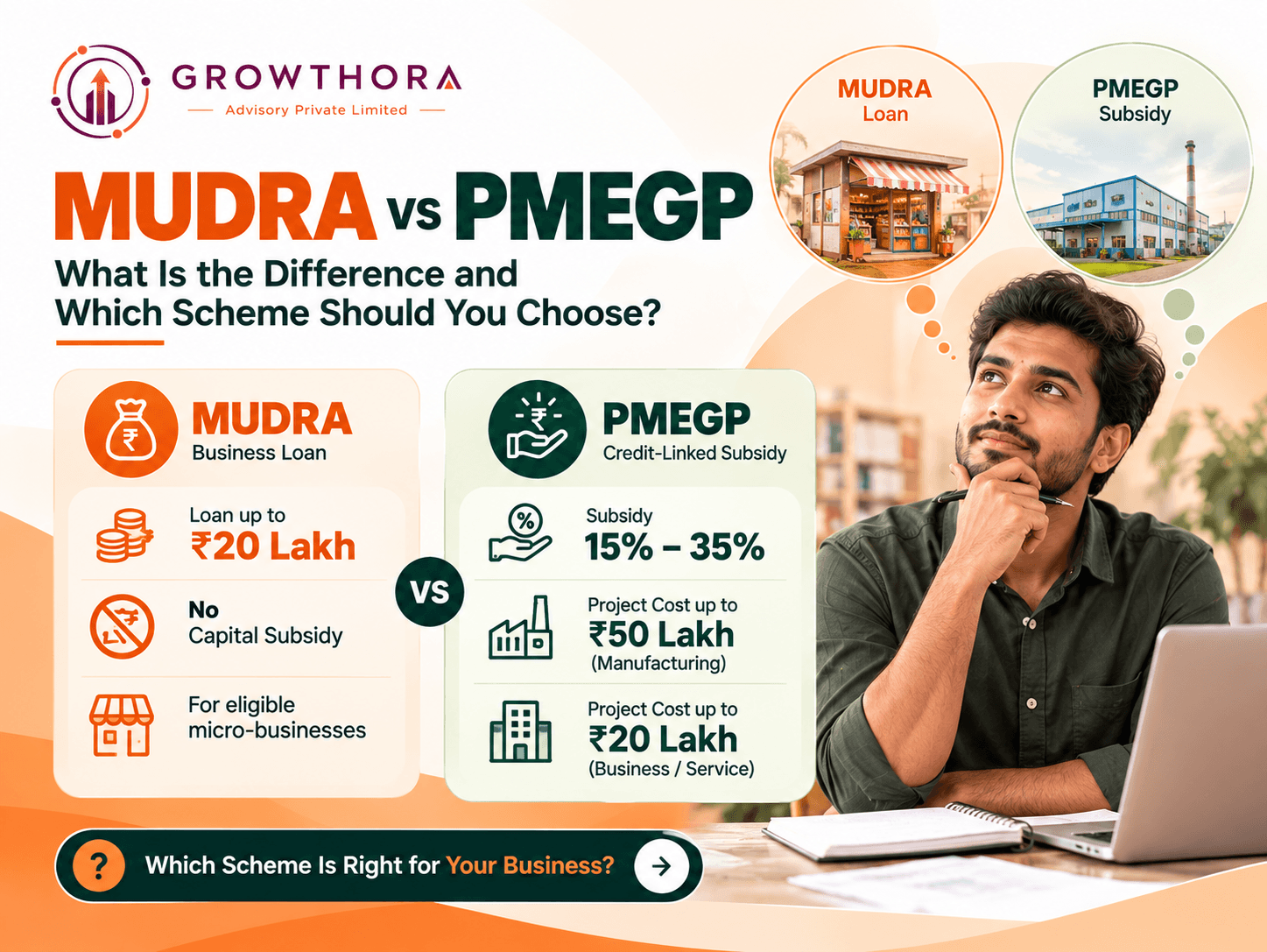
The key difference between MUDRA and PMEGP is how financial support works. MUDRA does not provide a capital subsidy under the standard loan scheme. PMEGP may provide margin-money subsidy for eligible projects, subject to category, location, guidelines, funds and bank approval. That potential subsidy comes with scheme conditions, so it should not be treated as cash paid upfront or as guaranteed loan approval
Mudra vs PMEGP: Quick Comparison
Use the comparison below as a starting point, then check the latest official guidelines and the lender’s terms before making a decision.
| Parameter | MUDRA (PMMY) | PMEGP |
|---|---|---|
| Type of support | Loan through participating lenders | Credit-linked loan with potential margin-money subsidy |
| Capital subsidy | No PMEGP-style capital subsidy | Generally 15% to 35%, based on category and rural or urban location |
| Loan or project limit | Shishu: up to ₹50,000; Kishore: above ₹50,000 to ₹5 lakh; Tarun: above ₹5 lakh to ₹10 lakh; Tarun Plus: above ₹10 lakh to ₹20 lakh for eligible borrowers who repaid a previous Tarun loan | Eligible project cost up to ₹50 lakh for manufacturing and ₹20 lakh for business/service |
| Promoter contribution | Depends on lender, product and borrower assessment; no single universal PMEGP-style contribution rate | Generally 10% for general category and 5% for special category |
| Purpose and scope | Eligible micro-business credit, subject to lender and scheme rules | Eligible new micro-enterprises in the non-farm sector; activity restrictions apply |
| New business eligibility | Subject to scheme and lender requirements | Primarily intended for eligible new units under current rules |
| Repayment | Loan plus applicable interest must be repaid | Bank loan plus applicable interest must be repaid; subsidy is processed under scheme rules |
| Best next step | Ask a participating lender about the applicable category, terms and documents | Check PMEGP activity eligibility, subsidy category, current guidelines and application process |
1. What is the MUDRA loan scheme?
Pradhan Mantri MUDRA Yojana, commonly called PMMY, supports eligible micro and small business activities through loans made by participating banks, small finance banks, non-banking financial companies and other eligible lenders. It can be relevant to activities such as small retail businesses, service providers, repair units, food-related enterprises and other eligible micro-businesses, subject to lender policy and scheme rules.
MUDRA loan categories are commonly described as Shishu, Kishore, Tarun and Tarun Plus. Shishu covers loans up to ₹50,000; Kishore covers above ₹50,000 and up to ₹5 lakh; Tarun covers above ₹5 lakh and up to ₹10 lakh. Tarun Plus covers above ₹10 lakh and up to ₹20 lakh for eligible entrepreneurs who have successfully repaid a previous Tarun loan. Tarun Plus is therefore not an automatic first-time loan limit for every applicant.
Under MUDRA, there is no PMEGP-style capital subsidy. The borrower must repay the sanctioned loan and applicable interest according to the lender’s terms. The lender assesses the business, repayment capacity, documents and credit profile. Collateral requirements are governed by the scheme framework and lender rules, but applicants should not interpret collateral-free finance as guaranteed approval.
2. What is PMEGP?
The Prime Minister’s Employment Generation Programme is a credit-linked subsidy programme administered nationally by the Khadi and Village Industries Commission (KVIC), with implementation support from state KVIC offices, State Khadi and Village Industries Boards, District Industries Centres and participating banks. Its objective is to encourage self-employment and create jobs through eligible new micro-enterprises in the non-farm sector.
For new units, the maximum project cost eligible for margin-money subsidy is ₹50 lakh in manufacturing and ₹20 lakh in business or service activities. The applicant contributes a prescribed share of the project cost, and the bank finances the remaining eligible amount subject to appraisal. If a project costs more than the scheme ceiling, any additional financing is not automatically eligible for PMEGP subsidy.
PMEGP subsidy rates generally range from 15% to 35% of eligible project cost, depending on applicant category and whether the unit is in an urban or rural area. Under the standard structure, general-category applicants contribute 10% of project cost and receive a 15% subsidy in urban areas or 25% in rural areas. Special-category applicants generally contribute 5% and may receive a 25% subsidy in urban areas or 35% in rural areas. Category definitions and qualifying conditions must be checked in the current official guidelines.
PMEGP assistance is generally intended for new eligible units. Applicants must meet programme conditions, and certain activities are restricted or excluded. A project should have eligible capital expenditure and a credible plan. Applying does not guarantee subsidy or loan sanction, and the subsidy is handled through the scheme’s prescribed banking process rather than being treated as an unrestricted cash grant.
3. Side-by-side comparison table
These are the main practical differences to consider when choosing between the two programmes.
| Parameter | MUDRA (PMMY) | PMEGP |
|---|---|---|
| Type of support | Loan through participating lenders | Credit-linked loan with potential margin-money subsidy |
| Capital subsidy | No PMEGP-style capital subsidy | Generally 15% to 35%, based on category and rural or urban location |
| Loan or project limit | Shishu: up to ₹50,000; Kishore: above ₹50,000 to ₹5 lakh; Tarun: above ₹5 lakh to ₹10 lakh; Tarun Plus: above ₹10 lakh to ₹20 lakh for eligible borrowers who repaid a previous Tarun loan | Eligible project cost up to ₹50 lakh for manufacturing and ₹20 lakh for business/service |
| Loan or project limit | Depends on lender, product and borrower assessment; no single universal PMEGP-style contribution rate | Generally 10% for general category and 5% for special category |
| Purpose and scope | Eligible micro-business credit, subject to lender and scheme rules | Eligible new micro-enterprises in the non-farm sector; activity restrictions apply |
| New business eligibility | Subject to scheme and lender requirements | Primarily intended for eligible new units under current rules |
| Repayment | Loan plus applicable interest must be repaid | Bank loan plus applicable interest must be repaid; subsidy is processed under scheme rules |
| Best next step | Ask a participating lender about the applicable category, terms and documents | Check PMEGP activity eligibility, subsidy category, current guidelines and application process |
4. Which scheme may suit your business?
Consider MUDRA if you need a loan for an eligible micro-business and want to explore funding without a PMEGP-style subsidy application. It may be worth investigating for working capital or business needs where the activity and lender product fit the scheme. The amount available depends on the relevant category, applicant eligibility and lender assessment. For a first-time borrower, do not assume that Tarun Plus is available.
Consider PMEGP if you are setting up a new eligible micro-enterprise and the possibility of a margin-money subsidy is important to your project economics. It may be more relevant for a planned manufacturing or service unit with defined capital expenditure, a detailed project report and a realistic employment and repayment plan. Check whether your exact business activity is permitted before spending money on application preparation.
A small shop owner looking for finance should check MUDRA and the lender’s eligible products first, while also verifying whether the specific retail activity is permitted under PMEGP. A person planning a new manufacturing unit may find PMEGP worth assessing because of its higher eligible project-cost ceiling and potential subsidy. These are starting points, not guarantees; the best option depends on business activity, project size, eligibility and lender appraisal.
5. Eligibility: what should applicants check?
For MUDRA, review the eligible business activity, loan purpose, amount required, identity and business documents, credit history, cash flow and lender-specific conditions. Ask the lender for a written list of required documents and the applicable interest rate, charges, repayment period and any security conditions.
For PMEGP, applicants generally must be individuals aged above 18 for new-unit assistance. At least an VIII-standard pass educational qualification is required for projects above ₹10 lakh in manufacturing and above ₹5 lakh in business or service. The scheme is intended for new projects, and existing units or units that have already received certain government subsidies may be ineligible for new-unit assistance. Additional rules apply to activity types, project cost, capital expenditure, family eligibility and mandatory Udyam registration before specified later stages.
Do not rely only on a blog, social media post or agent’s promise. Scheme guidelines can change, and an application may be affected by available funds, activity restrictions, bank appraisal or incomplete information. Confirm the latest requirements on the official MUDRA, MSME and PMEGP portals.
6. Documents to prepare
Document requirements vary by lender, applicant and project. Commonly requested items can include Aadhaar and PAN or other accepted identity documents, address proof, bank statements, photographs, business registration or licences where applicable, quotations for machinery or equipment, proof of premises, and a project report with cost estimates and expected cash flow.
For PMEGP, prepare a project report that clearly explains the product or service, market demand, equipment, working capital, employment plan, promoter contribution and projected income and expenses. The bank must be able to assess whether the business can repay its loan. Never inflate project costs or submit false documents. For MUDRA, explain how the funds will be used and how the business will generate enough cash to meet repayments.
7. Application process and practical tips
First, define the amount you actually need and prepare a realistic budget. Separate one-time setup costs from recurring working-capital needs. Compare the proposed loan repayment with conservative monthly cash-flow estimates rather than relying on best-case sales.
Next, check the current official scheme rules and whether your activity is eligible. For MUDRA, approach a participating lender and ask which loan category and product may apply. For PMEGP, follow the official application process and instructions from the designated implementing agency and bank. Keep copies of submitted forms and acknowledgements.
Before accepting an offer, ask for the sanctioned amount, interest rate, processing fees, repayment schedule, moratorium if any, security conditions and all other charges in writing. For PMEGP, also confirm how the margin-money subsidy is processed and what conditions apply before it is adjusted. A scheme label does not remove the need to review the actual loan terms.
8. Common mistakes to avoid
Do not assume that PMEGP subsidy is the same as an upfront cash payment. Do not assume every business activity is eligible under PMEGP. Do not treat the ₹20 lakh Tarun Plus limit as a first-time MUDRA entitlement. Do not choose a scheme only because its advertised limit is higher. Finally, avoid anyone claiming they can guarantee approval or subsidy in exchange for an unofficial fee.
The stronger application is usually the one supported by clear business logic, realistic costs, complete documents and a credible repayment plan. Eligibility is only one part of the decision; the bank’s credit assessment and the scheme’s current rules also matter.
Frequently Asked Questions
Q1. What is the main difference between MUDRA and PMEGP?
MUDRA provides eligible business loans without a capital subsidy under the standard scheme. PMEGP is a credit-linked subsidy programme for eligible new micro-enterprises and may provide margin-money subsidy according to applicant category and location.
Q2. Does MUDRA provide a government subsidy?
MUDRA does not provide a PMEGP-style capital subsidy under the standard PMMY loan categories. Borrowers repay the loan under the lender’s terms.
Q3. What is the maximum PMEGP project cost for a new unit?
The project-cost ceiling eligible for PMEGP margin-money subsidy is ₹50 lakh for manufacturing and ₹20 lakh for business or service activities, subject to current guidelines and eligibility.
Q4. Can a first-time borrower get a MUDRA Tarun Plus loan of ₹20 lakh?
Tarun Plus is intended for eligible entrepreneurs who have successfully repaid a previous Tarun loan. A first-time borrower should not assume they qualify for Tarun Plus.
Q5. Is PMEGP subsidy guaranteed after applying?
No. Application submission does not guarantee subsidy or loan sanction. Approval depends on eligibility, current scheme rules, available funds, project appraisal and the prescribed process.
Q6. Which is better for a new business, MUDRA or PMEGP?
Neither is universally better. MUDRA may suit an eligible micro-business seeking a loan without a capital subsidy, while PMEGP may suit an eligible new enterprise that meets the programme conditions and could benefit from margin-money subsidy. Compare your activity, project cost, own contribution and repayment ability.
Conclusion
The difference between MUDRA and PMEGP comes down to the type of support and the conditions attached. MUDRA offers eligible micro-business loans through participating lenders, with repayment and interest obligations but no PMEGP-style capital subsidy. PMEGP combines bank credit with the possibility of margin-money subsidy for eligible new projects, with limits and rates based on activity, applicant category and location.
Before choosing, verify the current official rules, confirm that your activity qualifies, prepare a realistic project report and compare the actual repayment terms offered by the lender. A suitable scheme is one that matches the business need and can be repaid sustainably, not simply the one with the largest advertised number.
Next step
Apply this to your business.
Confirm whether this applies to your legal structure, industry classification, and credit history - in under 30 minutes with an advisor.