
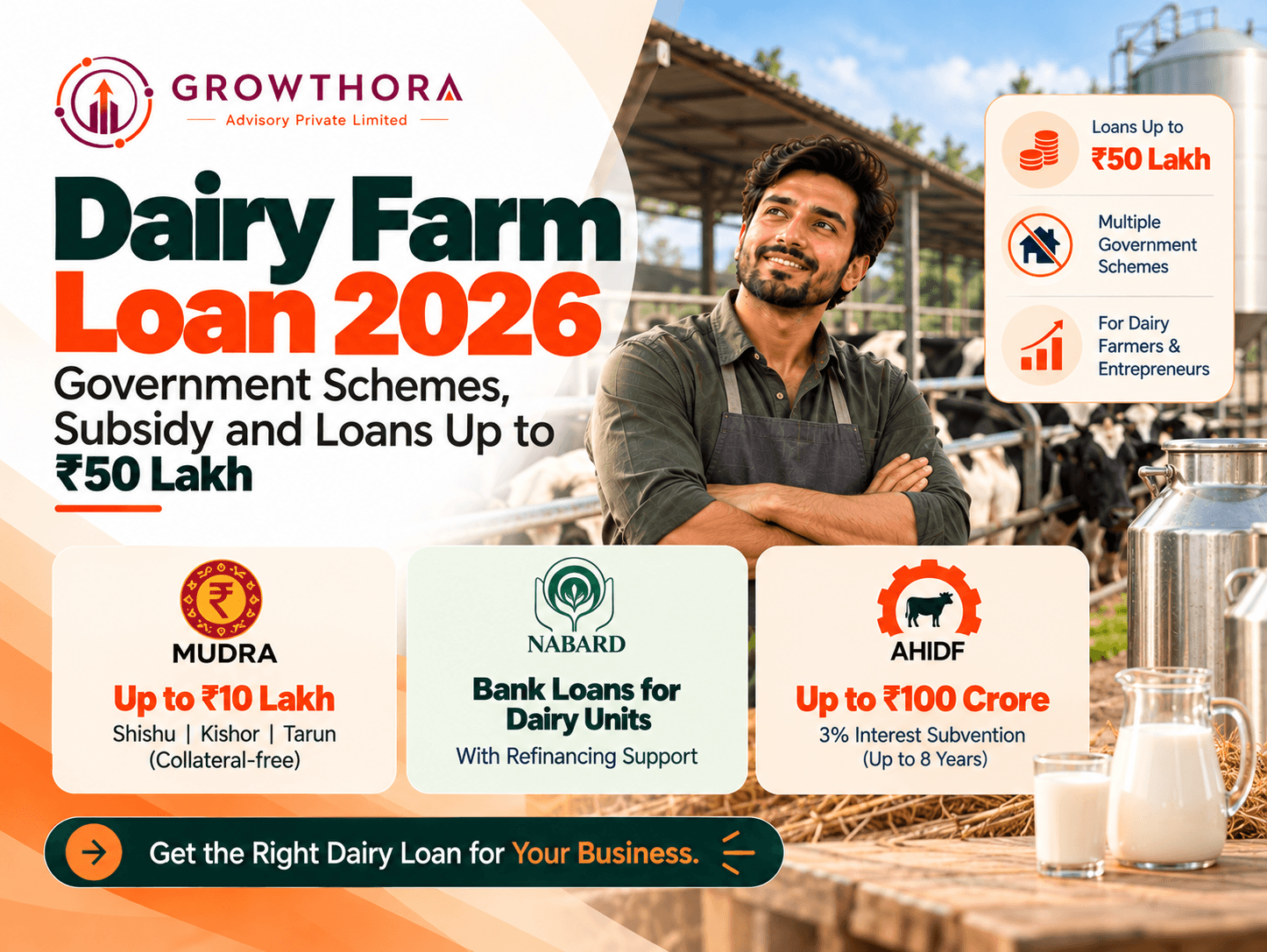
How dairy farm loans work in India in 2026
Dairy financing in India flows through commercial banks, regional rural banks, and cooperative banks, with NABARD providing refinancing and the Department of Animal Husbandry and Dairying running central schemes. A borrower applies to a bank branch with a project report, and the bank decides the loan amount, margin, and security based on the unit cost and repayment capacity.
The right route depends on scale. A farmer buying two to ten milch animals looks at Mudra, bank dairy loans, or Kisan Credit Card limits for animal husbandry, while an entrepreneur setting up a chilling plant, processing unit, or dairy product plant looks at AHIDF or term loans with a detailed project report.
Key Takeaways
- There is no single scheme that guarantees a ₹50 lakh dairy loan. The amount depends on project size, lender appraisal, margin money, and your repayment capacity.
- Mudra loans cover small dairy activities up to ₹10 lakh across the Shishu, Kishor, and Tarun categories and are generally collateral-free.
- AHIDF supports dairy processing, value-added dairy products, breed multiplication, and related infrastructure with a 3 percent interest subvention for up to 8 years, including a 2-year moratorium.
- The AHIDF implementation window was notified as running up to 31 March 2026, with disbursal for sanctioned projects allowed till 31 March 2027, so check whether the government has extended it before planning a new application.
- The DEDS back-ended capital subsidy of 25 percent and 33.33 percent for SC and ST borrowers is reported to have stopped from FY 2020-21, and many online articles still quote it wrongly.
- State governments run their own dairy and animal husbandry subsidy schemes, some with much higher subsidy percentages, so a state-level check is essential.
Main government-backed options at a glance
| Option | Best suited for | Key features |
|---|---|---|
| Pradhan Mantri Mudra Yojana | Small dairy units, cattle purchase, equipment and working capital | Loans up to ₹10 lakh in Shishu, Kishor and Tarun categories, generally collateral free |
| Bank dairy schemes and NABARD refinance | Farmers and entrepreneurs setting up or expanding dairy units | Loan size set by unit cost and appraisal, security as per bank norms, tenure usually up to 5 to 7 years |
| AHIDF | Dairy processing, value added products, breed improvement and related infrastructure | Term loans from ₹1 lakh to ₹100 crore, 3 percent interest subvention for up to 8 years, credit guarantee support for eligible MSMEs and cooperatives |
| Kisan Credit Card for animal husbandry | Working capital for feed, fodder and routine dairy expenses | Revolving credit limit with interest subvention on prompt repayment |
| State dairy subsidy schemes | Farmers in states that run their own pashupalan schemes | Subsidy percentages and eligibility vary widely by state |
Who is eligible?
- Individual farmers, dairy entrepreneurs, and women applicants who can run a dairy unit
- Self-help groups, farmer producer organizations, and dairy cooperatives
- MSMEs, private companies, and Section 8 companies for processing and infrastructure projects under AHIDF
- Applicants with a clean credit record and adequate land or shed space, fodder arrangement, and veterinary access
What a dairy loan can be used for
- Purchase of milk animals such as cows and buffaloes
- Construction of cattle sheds and milking, feeding, and storage infrastructure
- Milking machines, chaff cutters, bulk milk coolers, and fodder equipment
- Working capital for feed, medicines, and labor in the early months
- Dairy processing, packaging, cold chain, and value-added product units, subject to the scheme chosen
Documents usually required
- Aadhaar, PAN, and passport-size photographs of the applicant
- Land ownership papers or a lease or rental agreement for the farm or shed
- Detailed project report with unit cost, milk yield assumptions, and repayment plan
- Bank statements, income details, and existing loan details
- Quotations for animals, equipment, and construction
- Caste certificate where a category-based benefit is claimed, and Udyam registration for MSME units
How to apply for a dairy farm loan
- Decide on the unit size and scheme, whether a small farm loan, a Mudra loan, or an AHIDF processing project.
- Prepare a bankable project report covering cost, income, margin money, and repayment schedule.
- Approach a bank branch, regional rural bank, or cooperative bank, or apply through the relevant portal for the scheme.
- Submit the application with documents and go through the bank's field visit and appraisal.
- After sanction, complete documentation and receive the loan in stages against actual purchases and construction.
- Claim any applicable interest subvention or state subsidy through the bank as per the scheme rules.
Mistakes that delay dairy loan approvals
Weak project reports are the most common reason for delay, especially unrealistic milk yield and price assumptions. Applicants also lose time by relying on outdated subsidy percentages found online and then discovering at the branch that the scheme is no longer active. Confirm the subsidy position in writing with the bank before building your financial plan around it.
Frequently Asked Questions
Can I get a ₹50 lakh dairy farm loan from the government?
There is no single scheme that fixes a ₹50 lakh loan. Banks can sanction larger dairy term loans based on the project report, and AHIDF supports processing and infrastructure projects up to ₹100 crore, subject to eligibility.
What is the maximum Mudra loan for a dairy farm?
Mudra loans for dairy activities go up to ₹10 lakh, split into Shishu up to ₹50,000, Kishor up to ₹5 lakh and Tarun up to ₹10 lakh.
Is the NABARD DEDS subsidy still available?
The DEDS back-ended subsidy of 25 percent, and 33.33 percent for SC and ST borrowers, is reported to have been discontinued from FY 2020-21, so confirm the current position with your bank or NABARD office.
What interest benefit does AHIDF offer?
AHIDF provides 3 percent interest subvention on eligible loans for up to 8 years including a 2 year moratorium, for regular repayment.
Is collateral required for a dairy loan?
Small loans, including Mudra loans, are generally collateral free, while larger loans need security as per the bank's guidelines, though credit guarantee cover may reduce the requirement for eligible borrowers.
Which documents are most important for a dairy loan?
A bankable project report, land or lease papers, identity and address proof, bank statements, and equipment or animal quotations carry the most weight during appraisal.
Need a bank-ready project report for your dairy loan?
A realistic project report decides how quickly a bank sanctions your dairy loan. Book a free consultation with Growthora, and we will prepare your project report, shortlist the right scheme, and guide you through the bank application.
Next step
Apply this to your business.
Confirm whether this applies to your legal structure, industry classification, and credit history - in under 30 minutes with an advisor.